
Packaging and label converters are operating in a market where uncertainty has become part of daily business. Geopolitical disruption, volatile raw material prices, changing ink technologies and stricter packaging regulations are all putting pressure on production workflows.
For printers, this directly affects the availability, price and handling of inks, substrates and other materials. Global disruption can quickly affect oil-based raw materials, energy costs and petrochemical supply chains, creating concerns around cost, availability and production planning.
At the same time, the EU Packaging and Packaging Waste Regulation (PPWR) is moving the industry toward stricter circularity requirements. One of its main objectives is to make all packaging placed on the EU market recyclable in an economically viable way by 2030.
Together, these pressures show that packaging printers need ink workflows that are efficient, traceable and adaptable.
Uncertainty starts with raw materials
Many packaging ink systems depend on raw materials linked to oil, solvents, petrochemicals and global transport routes. When these markets are disrupted, the effect can move through the value chain, from feedstocks and resins to additives, substrates and logistics.
For converters, the main risk is not only higher cost, but unpredictability. Production planning becomes harder when an ink series, raw material or component is delayed, restricted or subject to sudden price changes.
This is especially relevant for flexible packaging printers using solvent-based inks. These inks remain important in many high-performance packaging applications, but they are also subject to safety requirements, volatile organic compound (VOC) management and raw material availability. As regulations and market expectations continue to move toward circular packaging, converters are increasingly evaluating whether their existing ink set and workflow is ready for the next phase.
Regulation is changing the definition of future-ready packaging
The PPWR reflects a broader shift from single-use packaging toward circular material systems. For converters, this means uncertainty is not only about short-term material availability or pricing, but also about whether current packaging structures, material choices and ink systems are ready for future circularity requirements.
One ink type alone does not determine whether packaging is recyclable. Flexible packaging depends on the complete structure, including substrates, barrier layers, adhesives, coatings, pigments, ink binders and the recycling stream used.
As design-for-recycling requirements become stricter, ink chemistry is becoming a more important part of the discussion. Nitrocellulose (NC)-free ink technologies are gaining attention because of their potential compatibility with polyethylene (PE) and polypropylene (PP) recycling streams, while NC-based inks remain widely used in solvent-based flexo and gravure printing.
For converters, the challenge is clear: production must remain stable today, while the ink room may need to support different ink systems, suppliers or material requirements tomorrow.
Waste reduction is also risk reduction
In uncertain times, every kilogram of avoidable ink waste adds extra cost. Overmixing, manual colour correction, poor return-ink control and unused leftovers are no longer just efficiency issues; they directly affect material availability, margins and production security.
Automated ink dispensing helps reduce this risk by producing the required amount of ink for each job with repeatable accuracy. Special software can help calculating how much of each colour is needed for the job, based on the print design. Return ink management adds another layer of control by making press-return inks easier to identify, store and reuse safely.
Another option is to adapt the hardware. For example, modular dispensing systems can be fitted with an extraction unit on the dispensing head to capture and reuse solvent vapours.
Ink changeovers need controlled planning
Changing from one ink system to another, for example from NC-based to NC-free or from solvent to water-based ink is possible in many cases, but it must be planned carefully.
Solvent-based systems generally offer more flexibility for evaluating water-based or alternative ink systems, while reverse conversions require additional safety measures. This makes gradual transition planning important for reducing risk, using existing stock and preventing unnecessary waste.
This gives solvent-based printers more flexibility to evaluate water-based inks or alternative ink systems. With solvent-based raw materials under pressure, a gradual transition may be worth reviewing. It can reduce risk, make better use of existing ink stock and help prevent unnecessary waste.
Modular dispensers adapt to changing ink requirements
A practical way to manage an ink transition is to run two ink sets on one modular dispensing system. For example, a Colorsat Compact can be configured so converters can continue using existing inks while gradually introducing a new ink series.
This can be done by using one side of the machine for one ink set and the other side for another, such as 16 components on the left and 16 components on the right. This creates a controlled bridge between the current workflow and the future ink setup.
Such a configuration can support a gradual move from solvent-based to water-based inks, testing a new ink supplier, separating ink technologies, using up existing stock and maintaining flexibility during raw material uncertainty.
GSE’s modular design also allows existing systems to be adapted with additional components, different pumps, agitators, or heating units where needed. This helps extend the useful life of the machine and makes existing equipment more flexible when market conditions change.
Extended machine life promotes resilience
The industry is beginning to recognise that lifecycle thinking is not only a sustainability issue, but a strategic one. Through refurbishment, upgrades and maintenance, equipment life can exceed 20 years, supporting circularity and reducing dependency on scarce resources.
In an environment defined by geopolitical tensions and supply chain instability, extending equipment life is not only environmentally responsible but also critical for operational security.
GSE’s Extended life Program provides a structured approach to maximise dispensing equipment longevity through remanufacturing, refurbishment, upgrades and lifetime support.
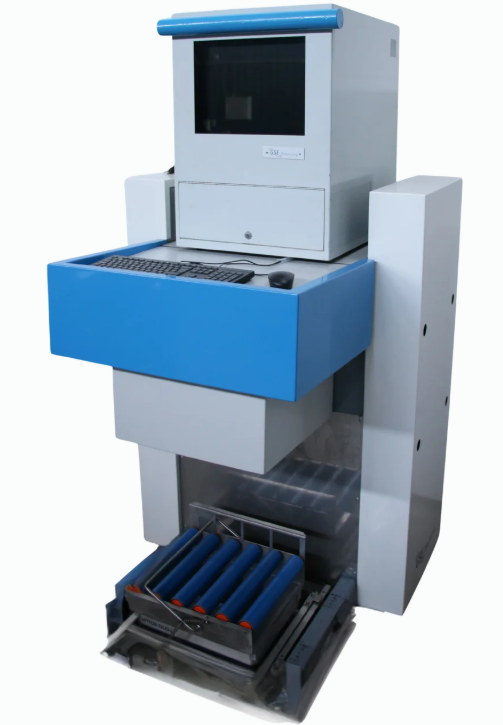
An example of a refurbished GSE Colorsat Compact
Building resilience in the ink room
Supply chain instability may well become the “new normal”. Converters that invest in lean, adaptable and digitally connected ink logistics will be better positioned not only to reduce costs and waste, but to continue operating effectively when disruption occurs.
Now is the time to take control of your ink workflow. Contact us to discover how our solutions can strengthen your resilience and future-proof your operation.
Want to know more?
Sign up here to receive regular updates on this blog series. Also, contact our sales team for a consultation, on email info@gsedispensing.com or telephone +31 575 568 080.