
What happens to ink room knowledge when the experts move on?
Skilled labour shortages are an issue that has become more prevalent recently. According to research, roughly 387 thousand positions in handicraft and printing will need to be filled between 2022 and 2035. Every year more experienced employees retire than there will be young talent coming in. We should not view this simply as an employee leaving: if their expertise is not transferred properly, valuable knowledge leaves with them. It has the potential to cause major downtime, waste and inconsistency, thus becoming a much larger issue than just having one employee less.
In a world brimming with new avenues of modernization, expectations of the young workforce start to change. Work in the manufacturing sector is seen as ‘dirty’ and performing repetitive mundane tasks is perceived as boring and unrewarding.
The printing industry faces an additional issue – visibility. Even if the issues mentioned above were to be managed perfectly, many young people looking to enter the manufacturing industry do not even know print to be an option open for consideration.
There are therefore three connected challenges:
- retaining the knowledge of the experienced workforce,
- attracting new talent, and
- reducing dependence on individual expertise through standardization and automation.
This series examines each in turn.
When knowledge walks out the door
The consequences of skilled labour shortages do not just end with having fewer employees on the shop floor. If left unaddressed it could cause a long chain of consequences.
It starts when an experienced employee leaves, they take their knowledge with them. This leads to the new hire having to figure out things that were previously known all over again, through trial-and-error. From here consequences can be divided into two categories – the effect on operations, and the impact on people. Failing to retain knowledge from experienced employees can spread remaining employees’ time and resources thinly, creating various bottlenecks in the process.
Without the right knowledge, new employees work more slowly and may become frustrated or lose confidence. This can make it harder to retain them.
Retaining your ink room knowledge
Due to years of experience, older employees have the knowledge to handle many different situations that are thrown their way, such as colour correction at the press, or how to handle press return inks. Many of these different small bits of knowledge are usually not properly documented in internal systems. This means that this information will be lost and must be relearned when the information leaves together with the experienced employee.
A dedicated knowledge system with work instructions and procedures is essential, as it is usually not possible to convey every small detail within the short period of an onboarding process.
The ink room typically combines hardware – such as an ink dispensing system, proofing system, spectrophotometer, and storage racks for press return inks – with software for ink management, colour measurement, and formulation.
The image below shows the relation between hardware and software, and how lacking the knowledge to combine these two results in wasted opportunities and resources.
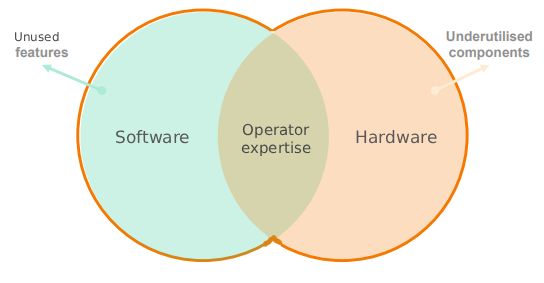
The intersection represents the expertise the operator needs, in order to fully utilize the features available to them. Achieving the maximum overlap depends on recording as much experienced operator knowledge as possible. This is necessary both to reduce waste, as well as to prevent the operator’s frustration at continually playing ‘catch-up’ to reach their predecessor’s level.
Creating a basis for training new talent
Detailed guides with standardized procedures help employees use the ink room’s hardware and software consistently.
GSE offers a wide range of resources for developing work instructions and standard operating procedures (SOPs).
For hardware, GSE provides comprehensive user manuals and an augmented reality tool that visualizes the equipment and its role in the ink room. The InkConnection blog also offers practical guidance, including:
- Housekeeping and cleaning essentials for your ink room
- Equipment maintenance for food-safe packaging printing
- Calibration and control of measuring devices
GSE also offers several software support resources. One example is GSE Ink manager’s integrated help function, which opens a web-based support page relevant to the screen the user is viewing. The InkConnection blog provides further step-by-step guidance on using GSE software, including:
- Advanced techniques for efficient return ink management in packaging printing
- Meeting quality standards for packaging inks with GSE Traceability
- Creating and adapting spot colours — made simple for package printers!
These resources can be supplemented with company-specific knowledge to help new employees handle situations beyond standard procedures.
Documenting this knowledge also prevents valuable expertise from being lost when an experienced employee retires or unexpectedly leaves their role.
These guides remain useful from onboarding through the early and mid-stages of an employee’s career. During onboarding, they provide a checklist to ensure that all essential knowledge is covered. Afterwards, employees can use them as a reference for details they may have forgotten or did not need initially.
Structured approaches for optimal onboarding
New employees should undergo an extensive onboarding process, consisting of the following elements:
- Introductory phase: A great introduction should allow the new hire to interact with the standard processes in an engaging way that connects with previous experience and knowledge taught during their education.
- Shadowing phase: The new recruit spends time alongside an experienced colleague, seeing how the job is done in practice, picking up the finer details, tips and techniques that are often learned through experience.
- Experimentation phase: After gaining a basic understanding of the processes in the ink room, the onboarding coach and the new recruit should switch roles. The new employee is given the chance to put their newly acquired knowledge into action, gain hands-on experience, and receive feedback from the onboarding coach, while the onboarding guide is available for reference.
GSE provides plenty of training services explaining every detail of machine operating / maintenance as well as an in-depth guide on how to use the Ink Manager software. This should additionally be supplied with repeated training to serve as a refresher and to ensure operators are aware of any changes.
Combining structured training with regular feedback and meaningful development opportunities creates an engaging environment where new employees want to stay and improve. It also helps prevent unnecessary wastes caused by essential details being overlooked during onboarding.
Stay tuned for our upcoming blogs to learn more tips and tricks on how to better connect with potential new talent as well as how to leverage standardization and automation so you can do more with less!