
In recent blogs, we explored how remanufacturing and modular product architecture help packaging printers reduce waste, extend system lifetimes, and lower their carbon footprint.
Yet these circular strategies depend on one critical enabler: data. Without structured, accessible, and reliable data, circularity remains a concept. With it, circular systems become measurable, scalable, and commercially viable.
This introductory blog explains why data is the backbone of circular dispensing systems and provides a framework for understanding how information flows from machine-level signals to lifecycle intelligence.
From machines to lifecycle intelligence
Modern ink dispensing systems are no longer standalone machines. They operate within a connected ecosystem that brings together production operators, service teams, ERP systems, and ink suppliers. They are also part of a more complex information chain in today’s digital, sustainability-driven age.
At one end are the machine’s sensors and controls, measuring weights, valve movements and component tank levels in real time. At the other are management information systems that schedule production, order inks, and analyze costs and consumption. Between them sits the software that turns production plans into dispensing instructions, and records when happens in every ‘dispensing event’.
Different levels of information
IT specialists often describe this chain using the ANSI / ISA95 standard. This provides a universal language for connecting different software and control systems, so that information flows smoothly, from the shop floor to the boardroom. It is visualized as a pyramid, showing how data is filtered and summarized as it moves up, also increasing in terms of time-frame and scope.
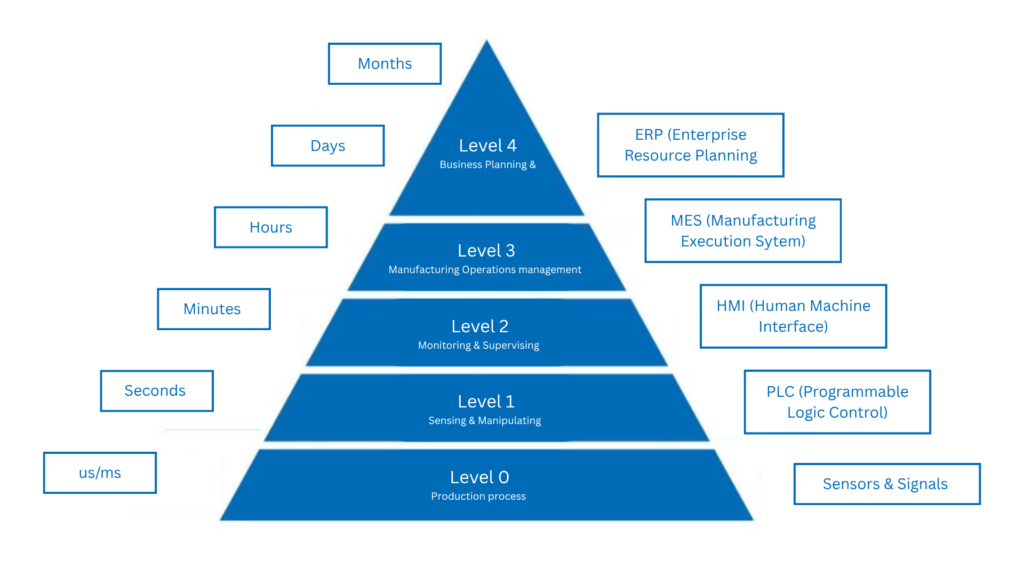
Each level has its own role. Lower levels capture and control machine behaviour in real time, while higher levels translate operational data into workflow coordination, lifecycle planning, and financial insight.
The real value does not come from these layers in isolation, but from the way they are connected. When data flows reliably between levels, it becomes possible to link machine performance to production efficiency, maintenance needs, and long-term lifecycle decisions.
Data in GSE’s ecosystem
In a typical GSE setup, the information structure can be understood in four connected layers:
- Sensors and signals (Level 0): Sensors for automatic bucket and blender positioning, weighing scale signals, and level measurement signals from connected base-colour tanks.
- Machine control (Level 1): GSE’s Real Time Controller (RTC), which controls machine stations such as automatic conveyors, dispensing heads, weighing scales, and blenders.
- Operational intelligence (Levels 2-4): GSE Ink manager software, which collects, structures, and manages dispensing and ink workflow data.
- Business integration (Levels 3-4): Interfaces with the packaging printer’s ERP or MES systems, enabling ink-related data to support broader production and business processes.
The RTC connects directly to sensors and machine signals to retrieve control data and manage feedback loops. It also communicates with GSE Ink manager, passing on machine signals while receiving dispensing tasks in return. In addition, the RTC can provide data such as valve stroke counts and pump running time per component, which can serve as input for predictive maintenance. GSE Ink manager can then connect through the company network to the packaging printer’s ERP or MES system.
Over time, GSE Ink manager functionality has expanded beyond operational data management, increasingly supporting level 4 activities such as planning, purchasing and booking in inks, and business insight – especially for smaller companies with limited or no ERP functionality.
A real-world data structure in practice
In practice, data does not remain within one organization. A connected dispensing environment brings together several stakeholders, each contributing different types of information and value throughout the system’s lifecycle.
- The packaging printer, where the dispensing system operates and where production, ink usage, and operational data are generated.
- GSE, providing software updates, technical support, lifecycle services, and system expertise.
- The ink supplier, which may be connected through cloud platforms to support ink availability, formulation data, and supply chain coordination.
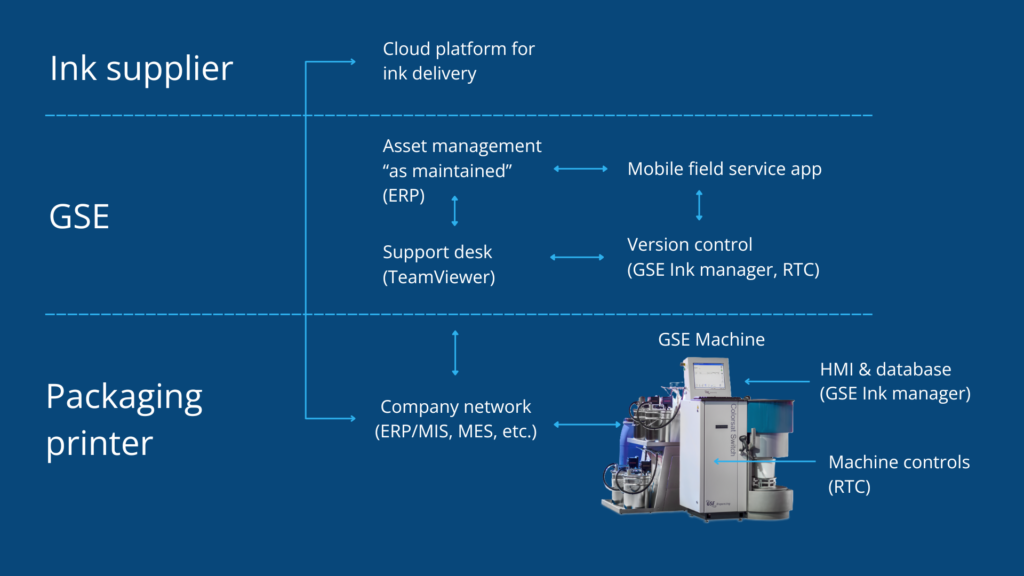
Together, these connections create a lifecycle data ecosystem. This ecosystem supports visibility from installation and daily operation to maintenance, upgrades, remanufacturing, and future service models.
Unlocking circular value with data
Every dispenser has a life-story. It starts with the way it was designed, continues through installation and day-to-day production, and changes as components wear, are serviced or get upgraded. Capturing this information creates a digital history of the machine.
An isolated reading says little, but thousands of recorded events start to reveal patterns. Sometimes, these patterns can be a machine’s early signs of failure that are too small, too gradual, or complex for humans to perceive.
Suppose that the software picks up slight increases in valve actuation, drifting dispensing accuracy, increases in electrical current – or a combination of these signs. Accumulated data becomes useful enough to shape decisions. Instead of treating every service visit as a fresh inspection, engineers can see how the system has changed over time, spot wearing issues early, and schedule maintenance before a more serious symptoms develop – averting unplanned production stoppage or costlier machine damage.
Historic data can also be used for digital product passports and carbon footprint calculations, to support compliance.
The greatest value emerges when data is analyzed across functions and systems. By connecting machine performance, ink consumption, service history, and business data, packaging printers can turn circular ambition into operational reality.

Day of Remanufacturing 2026 event with 20+ year old GSE dispense machine on display.
What’s next?
This blog opens a new series on the data foundations of circular dispensing systems. In the next articles, we will explore how connected data can be secured, migrated, standardized, and applied to reduce waste and extend system lifetimes.
Because in the end, the question is not whether dispensing systems generate data. They already do. The real question is whether that data is structured, connected, and used effectively across the full lifecycle.
Want to know more?
Sign up here to receive regular updates on this blog series. Also, contact our sales team for a consultation, on email info@gsedispensing.com or telephone +31 575 568 080.