
In our previous blog, we explored how reducing CO₂ can start with practical decisions such as refurbishing instead of replacing, for example through remanufacturing dispensing valves.
That same sustainability principle applies not only to individual components, but to the way equipment is designed.
A product architecture describes how a product’s functional elements are arranged into physical building blocks (“chunks”) and how these building blocks interact. When that architecture is modular, functions map cleanly to physical components, interfaces are well defined, and parts can be replaced, upgraded, refurbished, or reused without forcing replacement of the entire machine.
For industrial equipment, this distinction is critical because different parts of a system age at different speeds. Mechanical platforms can remain reliable for decades, while control electronics and software evolve much faster.
A clear illustration of this can be seen in the first generation of automatic dispensers: their machine controls could not be upgraded because they were custom‑built and relied on PCB components that eventually became unavailable. As a result, otherwise functional machines had to be completely replaced. Modular architecture avoids this outcome by allowing each “layer” of a system to evolve independently, extending overall machine life and significantly reducing waste.
Why modular architecture supports sustainability
Modularity supports sustainability in several direct ways:
- Life extension by design: long‑life modules such as mechanics and dispensing hardware are retained, while short‑life modules such as electronics and computing can be replaced when needed.
- Lower material waste: mechanically sound equipment does not need to be scrapped because one subsystem becomes outdated.
- Remanufacturing and repair: modular components are easier to remove, refurbish, and reintegrate, as seen with dispensing valves.
- Upgradeability: improvements can be introduced without redesigning or reinstalling the entire system.
In short, sustainability is not only about what materials a machine uses, but about whether the machine was designed to adapt over time.
A practical example: upgrading the control layer without replacing the machine
One clear example of modular architecture in action is a control‑system upgrade. Instead of replacing an entire dispensing installation, the upgrade targets the computing and control layer, while keeping the proven mechanical platform and dispensing hardware in place.
GSE distinguishes between machine control software and user interface ink management software in the control of its dispensing systems. The latter runs on standard Windows 11 PCs, while the former runs on real-time industrial computers (whereas other brands often use PLCs for this)
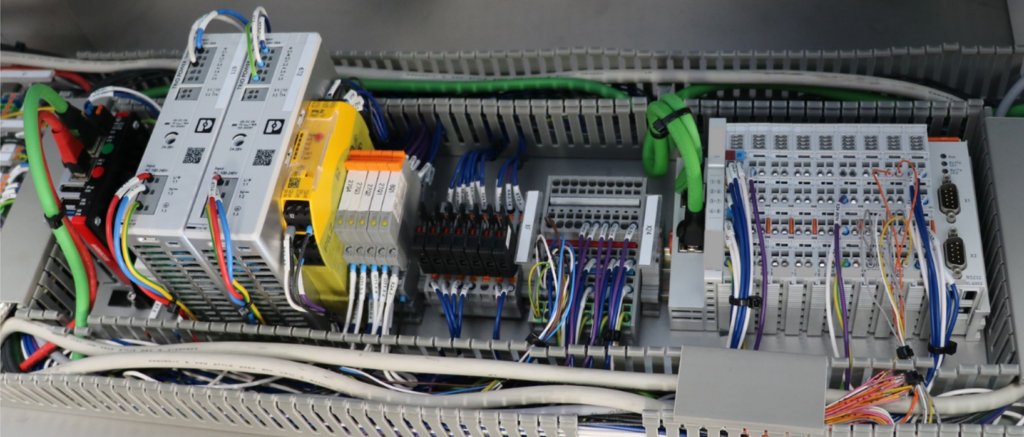
Depending on the control configuration of the existing installation, GSE offers different upgrade packages.
When operating-system lifecycles change, modularity allows users to modernise what must change, without discarding what still performs reliably.
What gets upgraded (and what stays): modular architecture in one view
Depending on the existing installation, upgrade packages may include:
- A Windows 11 PC
- Real-time control computer replacement – when existing hardware cannot support Windows 11
- Input/output (I/O) hardware refresh – for older installations
- Software update – installation of the latest GSE Ink manager
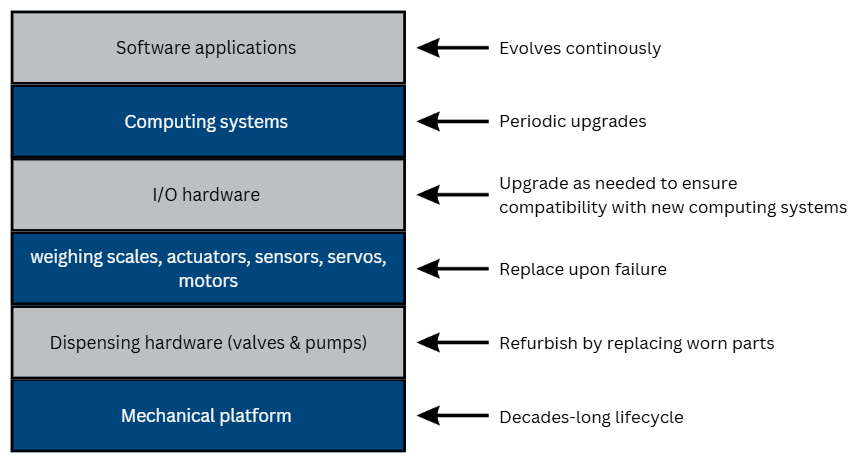
Modularity in software: evolve without forcing replacement
Modular architecture does not stop at hardware. GSE’s Ink management software is designed with a modular software structure that allows additional functions to be activated when needed. This enables the system to grow with new requirements without forcing a full replacement cycle.
This is especially important in production environments where workflows remain stable, but requirements change over time, such as traceability, reporting, connectivity, or integration with higher-level MIS systems. Modular software allows these capabilities to be added while preserving the existing system.
Sustainability and cost: one design decision, multiple benefits
Extending equipment lifespan reduces the accumulated CO₂ footprint of production assets by avoiding unnecessary manufacturing, transport and disposal of large systems. The same refurbishment logic used for individual components becomes scalable across the entire machine when modular architecture is applied.
From a cost perspective, modernising a control layer is typically far more efficient than replacing an entire dispensing system. The existing mechanical platform remains in service while only the required modules are refreshed.
This approach typically results in:
- Lower capital investment
- Reduced engineering and installation effort
- Shorter downtime during upgrades
- More predictable long‑term maintenance planning
Conclusion: design machines to adapt, not to be replaced
Many industrial systems remain mechanically sound for decades. The real challenge is rarely the frame or the dispensing hardware, but the shorter‑lifecycle modules around computing, controls and software.
A modular product architecture makes sustainability practical. It allows machines to adapt over time, extend their usable life, reduce waste, and remain secure and supported by upgrading only what truly needs to change. A Windows 11 upgrade is simply one example of how modular design turns inevitable technology changes into manageable, low‑impact updates rather than full replacement cycles.
Want to know more?
Sign up here to receive regular updates on this blog series. Also, contact our sales team for a consultation, on email info@gsedispensing.com or telephone +31 575 568 080.